
Have you ever stopped and really thought about the English language? If English is your first language, you have probably not given it much thought since grade school when you were in the cusp of learning everything there was to know about it…and then eventually forget as time went on.

As a writer, I am intrigued by words. Not only their meanings, but their spelling. Words like bamboozle (to deceive or be tricked) or fardel (a bundle or pack) or kerfuffle (to cause a disturbance or fuss).
And then my mind often wanders to thinking who actually created these words? I know English words began taking shape back in the mid-5th century A.D., but who is actually responsible for certain words.
Were they created at random one person at a time who then just started sharing the word till it caught on? Much like slang words of today. Was there a committee who got together to brainstorm new words? Was there a public vote when new words were created? And then who decide on the spelling? A whole other committee? All of this we will mostly likely never fully know.
By now you are probably wondering: What sparked this wonder with words and the need to write about them? I will tell you.
It was the English word HETERONYM.
Do you know what that means? We most likely learned about it in grade school along with the words synonym and antonym.
Heteronym is a word spelled the same but has a different pronunciation.
Heteronym was the theme for last week’s Super Quiz. Every Saturday, located below the comics in the local newspaper, there is a Super Quiz. I love this Super Quiz because it so eloquently reminds me how much I know or how much I should know. My Mom and I used to send these quizzes back and forth to each other when one of us was stumped by it. Needless to say, I sent more to my Mom than she sent to me!
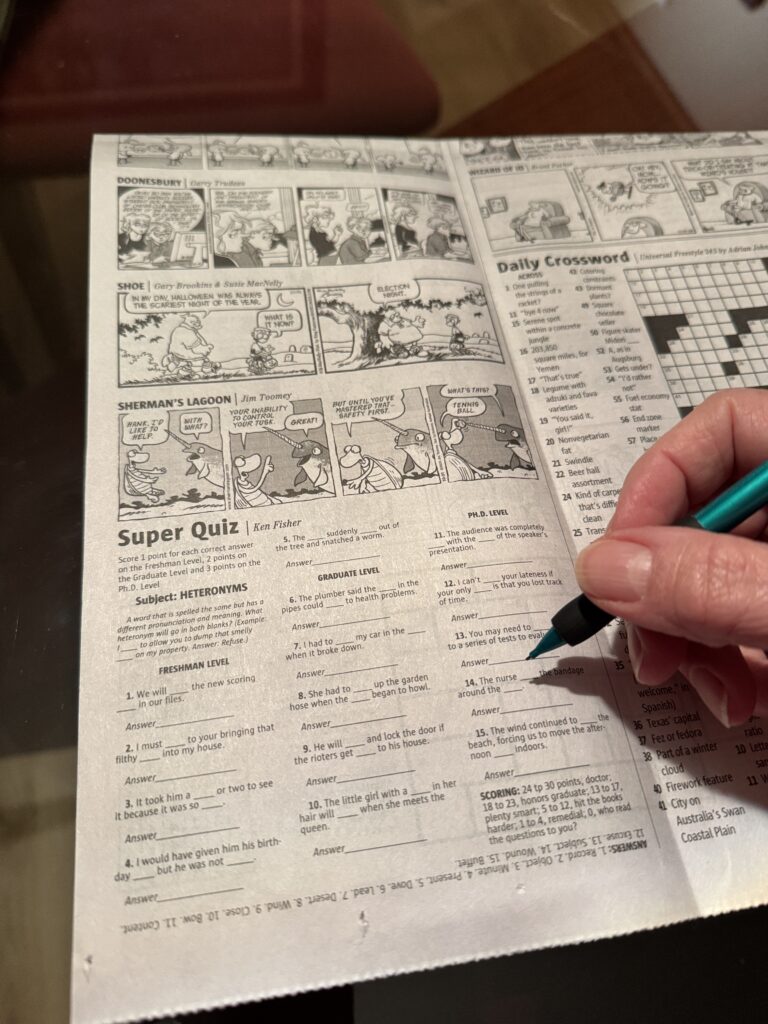
The Super Quiz was created by Ken Fisher, a.k.a. the “Wizard” when it comes to developing games. And who better to remind us of the nuances of the English language than an English as a Second Language teacher from Toronto, Canada.
Here are a few examples of Heteronyms from last week’s Super Quiz:
1) The ________ suddenly ________ out of the tree and snatched a worm.
2) It took him a ________ or two to see it because it was so ________.
3) She had to ________ up the garden hose when the ________ began to howl.
This took me back to the spelling of words and obviously their pronunciations. I mean, how can you have two words spelled the same but pronounced differently? Who decided that one?
The answers to the Super Quiz are as follows, in case you did not figure them out for yourself: 1) Dove 2) Minute 3) Wind.
In the first example, why wouldn’t the second dove be spelled more like it is pronounced: douve. In 2 the word is minute. Why wouldn’t the second minute be spelled mynute. And finally in 3, the word is wind. Why wouldn’t the first wind be spelled wynd.
Okay, I know it all goes back to the way a word functions. Is it a noun, an adjective, or a verb. Each depicting a different meaning depending on how it is used. So then who came up with whether a word is a noun, adjective or verb? You see where I am going with this. It’s like a black hole you can’t find your way out of.
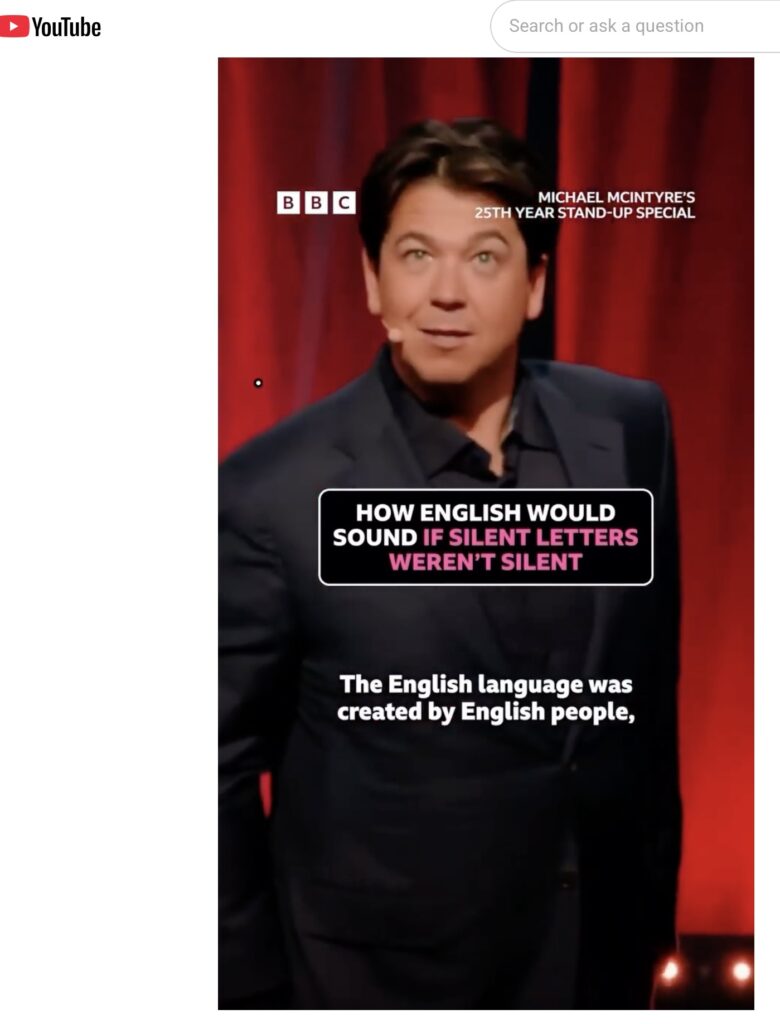
And don’t get me going on the words with letters that aren’t even pronounced in a word. The British comedian, Michael McIntyre, has done it brilliantly as you can hear here – look those two words sound the same but are spelled differently! Those words are called a homonym, and more specifically homophones.
Click photo of Michael for a good laugh!
I hope this brought a smile to your face and a little wonder to your brain! And the next time you come across an interesting word or pronunciation, thank the invisible person or entity that was behind its creation.
And the next time you invent a new word or come across a really interesting one, share it with me. I am always looking for new words to add to my vocabulary.
Feel free to share this post with those you know who are a stickler for the English language or those who just find wonder in words.
SIGN UP FOR NEW BLOG POSTS
Receive new writings and author updates from Karen B. Shea in your email inbox
